Gaza Ceasefire: WHO, others upscale humanitarian deliveries, emergency health plan

The World Health Organisation (WHO) says Gaza ceasefire could boost aid deliveries to 600 trucks daily amid reports that Israel’s security cabinet has given the green light to a ceasefire deal with Hamas. Dr Rik Peeperkorn, WHO representative in the occupied Palestinian territories (OPT), expressed the optimism in a statement on Friday. “The target is to get between 500 and 600 trucks in per day over the coming weeks,” Peeperkorn said. This would represent “a huge increase” from the 40 to 50 lorries reaching Gaza in recent months and be similar to the level of aid reaching Gaza before war erupted on Oct. 7, 2023. Speaking from Jerusalem, the WHO medic described the ceasefire announcement as “a sign of hope”. He, however, warned that the challenge is massive and daunting, because of chronic and severe shortages of food, fuel and medical supplies. READ ALSO: Suspected cholera outbreak kills 9 in Rivers State According to him, plans are in place for deliveries to begin on Sunday. “We have ordered temporary prefabricated clinics and hospitals. “We will integrate into the existing health facilities as part of plan to expand some needed bed capacity, address urgent health needs and health service delivery.” Humanitarians have repeatedly warned that the crisis in Gaza for civilians has reached catastrophic levels. More than 46,000 people have been killed, according to the authorities and more than 110,000 have been injured – often with life-changing injuries – since the conflict began in October 2023. “Disease is spreading and the risk of famine remains high – needs that are critical to address, especially when more than 12,000 patients – a third of them children – still await evacuation for specialised care,” Peeperkorn said. READ ALSO: Cervical cancer: fourth most common cancer in women He complained that the pace of evacuations has been painfully slow. Of 1,200 requests submitted between November and December 2024, only 29 were approved, a rate of just 2.4 per cent, according to WHO. The WHO and other agencies have stressed the immediate need to provide food, water and medical supplies, but also fuel and spare parts for hospital generators. Gaza’s healthcare system has been shattered, with only half of its 36 hospitals currently operational. Critical health infrastructure continues to be targeted, according to the UN health agency, which pointed to 664 healthcare attacks since October that have caused deaths among civilians and medical workers, also damaging vital health facilities. In spite of the dire conditions, WHO aims to implement an ambitious 60-day emergency health response plan, once a ceasefire kicks in. This includes scaling up existing health efforts, setting up temporary medical clinics and restoring essential healthcare services. Efforts will also focus on combating malnutrition, bolstering disease surveillance and providing medical supplies to areas that have been difficult to access until now. According to WHO, more than $10 billion is required to restore Gaza’s shattered healthcare system, and substantial international support will be essential to avoid further loss of life and prevent a complete breakdown of the region’s health infrastructure. In addition to addressing the immediate health needs, there is also a pressing requirement for broader humanitarian aid. Food, clean water and shelter are fundamental priorities, alongside other crucial medicines and medical equipment which remain in desperately short supply. For the moment, international agencies continue to work under difficult and dangerous conditions, hoping that the ceasefire will offer a lifeline to those trapped in the besieged enclave.
The carnage in Gaza: A Blight on Our Collective Humanity: It. Must End Now
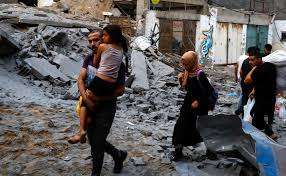
It is ungodly and unchristianly to support the brutality and genocide being perpetrated against Palestinians in Gaza. Legal minds might argue whether or not the wanton killing of tens of thousands of innocent children, women and the aged in Gaza meets the legal threshold of being described as genocide, but people of good conscience know what genocide looks like when innocent people are being killed on an orgy of collective punishment and retribution. Yes, I am a Christian, but I would rather be an agnostic than worship any God or religion that supports the crudity and inhumanity taking place in Gaza and the West Bank. That was the reason I walked out of my old church in Miami with my family in 2004 during the Israelis-Hezbollah war in Lebanon when women and children were being slaughtered by Israelis bombing. At the height of the war, my pastor stood on the pulpit to justify the killing of Muslims and Palestinian refugees in Lebanon as part of the fulfillment of biblical end-time prophesies. I totally lost it. I stood up in the middle rot the sermon and was about to yell obscenities at him. My wife’s pleading and covering my mouth was what saved the day. That moment, I knew I couldn’t serve the God that my pastor pretended that p be serving. I stood up in rage with my petrified wife I tow, went to the children wings where my children were worshipping, took them up and drove off of the parking lot never to return. That church was our family church for nine years. It was the church where my children were baptized. My children have never forgotten that experience and have now become activists and advocates on behalf of Palestinians. Sadly, that is experience has shaped their attitude toward church and religion in general even though we immediately found another church where they were raised in the Christian faith. Sadly, some misguided Nigerian pastors and so-called Christians who have not read their Bible where it spoke about Christ drinking water from the Samaritan woman in the well, blindly support the Israelis on the basis of some misguided biblical injunction. I have a firsthand experience seeing face to face the worst form of apartheid in Palestine when I spent the summer of 2020 as a visiting professor at the Palestine Polytechnic University in Hebron. I saw Israelis soldiers with guns watching over every move of the Palestinians, taking their land and demolishing their homes and farmland. I witnessed the economic strangulation of Palestinians by the Israeli authority in a two-tier economy where the Palestinians are living like refugees in their homeland, deny the right of free movement and access to the holy Al-Aqsa Mosque in East Jerusalem. I was with a professor friend of mine who had taken me and my wife to the holy Ibrahimi Mosque in Old City Hebron. My good friend during that visit wanted to show my wife and I the house where he took his fresh breath and where he spent his youthful formative years and where his family ran a shop in the Old Hebron market. Of course, we were all excited to see where this great friend of ours and gentle soul grew up. To my and my wife utter shock, as we attempted to cross the security post erected by gun-trotting teenage Israeli soldiers, my wife and I were asked to show our passports. As naturalized African immigrants with US passports, the Israelis soldiers respectfully ushered us in. He bluntly refused our Palestinian Professor friend access to cross the line of divide in his own town and place of birth. It was the first time in my entire life when being black gave us special privilege. Of course, I wasn’t fooled for a second that the teenager soldier would have sent my black butt back without the U.S. passport. We all have read about the second-class status of black Ethiopian Jews in Israel. Of course, have been a victim of racism and racial discrimination ourselves, my wife and I insisted we weren’t going to cross the security line without our Palestinian brother and friend. We also insisted on crossing that line and visiting the site. The soldiers ultimately gave in to our demand giving us just 5-10 minutes. We could sense being watched by the soldiers at the gate and Israelis soldiers at the ubiquitous watchtowers that sits atop of the site, and which dots the landscape of occupied West Bank. I would never forget the tears I shed with young brilliant Palestinian students in a school in Nablus where I had gone with a U.S. Embassy staff to teach these teenagers about entrepreneurship. Some of these teen Palestinians were dual U.S.-Palestinian citizens. They spoke of being trapped in a hopeless enclave with no access to basic Google map, unable to partake in the global digital economy, unable to order and have anything delivered via the online marketplace. They spoke about the constant harassment and imprisonment by the occupying Israeli military. I remember being accompanied by two armored SUV and a contingent of almost 8 heavily armed contract private security company who stood guard even at the door of the school bathroom when I went to ease myself. Mind you, this was an empty high school campus on vacation. There were just about 20 students who were bused in to receive me and the US Embassy staff from Jerusalem plus about three officials of the school. We were ushered into the town by a police rider with siren. I felt totally scandalized by this unnecessary militarization of an innocuous visit to young Palestinians and the sense of siege it created on these young souls and their community. Imagine leaving on a daily basis under such a siege. Well, that is the daily existence of Palestinians in the West Bank. That siege does not spare anyone in the West Bank. During my Fulbright stint at the PPU, I was privileged to participate